Introduction
One of the most irritating gaps experienced during the hardware product development process is that of transitioning between the virtual world and physical reality – the gap that makes the first stamped out sample not live up to expectations, leading to iterations, delays, and extra spending. Often, the reason behind such a disappointment does not have anything to do with poor manufacturing capabilities of your stamping service provider. The real culprit is the inability to translate your intentions into action plans.
In many cases, designers’ creative intentions fail to communicate clearly to the metal stamping services provider, resulting in fatal mistakes like the wrong size of bend, location of mounting holes, etc. This guide will provide you with a thorough set of actions to ensure a “zero-loss” communication strategy between your company and the stamping service provider.
What Makes a “Manufacturable” Design File More Than a CAD Model or a 2D Drawing?
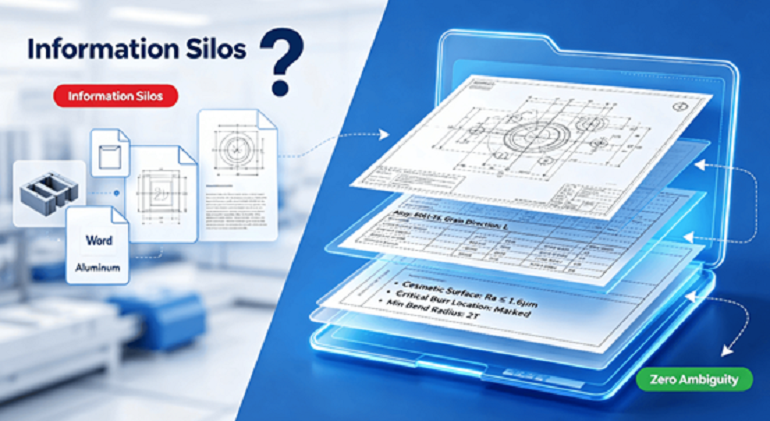
A manufacturable design file is more than just a simple CAD model or a 2D drawing; it contains information in sufficient detail to rule out any ambiguity. Incomplete information creates “black holes of information” for the manufacturer to interpret on their own, resulting in mistakes. An adequate data package must not only include geometric details but also functional relationships, material properties, and desired finishing.
1. Importance of Geometric Dimensioning and Tolerancing (GD&T)
Dimensioning without GD&T is like having a map without its legend. While a map indicates where the features lie, without a legend we cannot determine the relationship between different features nor their functionality. GD&T Standards are an engineering language allowing us to convey information regarding form, orientation, location, and runout of our parts. For example, specifying that certain features must fall within a narrow cylinder tolerance zone measured from the datum guarantees proper alignment with mating components – a feat not achievable with ±tolerances alone.
2. Specification of Materials Other Than the Base Metal Name
Simply saying “aluminum” or “stainless steel” is not sufficient. You have to specify the exact alloy and temper (for example, 6061-T6, 304 Stainless Steel, 1/2 Hard). The metal temper is a measure of how hard, strong, and stretchable a metal is; it can have a considerable effect on the way that it is formed. If a component is intended to be formed from a certain temper but is actually formed from a harder temper, it could crack, and if it is formed from a softer temper, it might not hold its shape properly. This is something that you must have in your specification if you are designing something for manufacturing with precision.
3. Surface Finish and Critical Features
The drawing should specify which surfaces will have cosmetic purposes versus those that are purely functional. It should also indicate which surfaces will require a seal or have other special requirements regarding their surface roughness (expressed as Ra values). It should specify which features are critical and which are not. For instance, a slight burr on a surface inside the part is not an issue, but one on an outside or sealing surface is unacceptable.
How Common Are the “Lost in Translation” Mistakes in Metal Stamping Projects?
Miscommunications in metal stamping can be categorized into specific mistakes that occur regularly. Identifying such problems early in the project helps avoid them through proper planning and design. They generally arise because the team does not share enough knowledge regarding what happens to the materials during the metal stamping process.
- The Unintended Consequences of Burr Location: Most drawings do not indicate the orientation of the burr. In metal stamping, burrs are created when metal is sheared using a die. Burrs form in the opposite side of the shearing process. This could create issues in projects where a burr might end up being formed in critical areas like the sealing surfaces or a handle edge. However, in a professionally designed metal stamping process, the burr is planned to be formed along the non-critical areas.
- The Direction of Material Grains and Its Effect on Formability: When dealing with sheets made of metals, it should be noted that the process of their creation involves the development of grains in materials. When it comes to bending along the direction of grain alignment, less force is required but it leads to an increased radius of curvature. It is necessary to apply additional forces in order to bend perpendicular to grains and it may also cause cracking. It is critical to consider the direction of grain while preparing the flat pattern of multi-bend parts, especially those characterized by a high tolerance, to avoid cracking.
- Dangers of Sharp Corners and Minimum Bend Radii: It is common practice in modeling to use sharp internal corners as there are no obstacles while designing a digital object. However, when the piece of material is being bent, it is subjected to stretching on the outside and compressing on the inside. When the radius of bend is too small relative to the thickness of the material, cracking or thinning will occur. Sharp inner corners also act as stress concentration points, which leads to rapid die wear.
What Is the Impact of Conducting a Proactive DFM Review in Working with a Metal Stamping Company?
The key approach to bridging the gap between the physical and digital world is conducting a proactive design for manufacture (DFM) review. This is an interaction rather than just criticism, during which process knowledge is used by the metal stamping company to achieve optimization in terms of price, quality, and reliability of your parts. Thus, the role of your partner changes from a mere executor to a technical collaborator.
1. Unlocking Cost and Performance Optimizations
By conducting the analysis, the precision metal stamping service company will be able to detect potential areas for optimization that cannot be detected by designers themselves. The company will advise you to eliminate welding operations and replace weld nuts by clinching or extrusion holes; it will find a more economical and reliable method of forming, thus saving money on your parts.
2. Avoiding Catastrophic Failures in Tooling & Manufacturing
DFM review is also a method to prevent risks associated with manufacturing defects. During simulation, the manufacturer can identify elements of the design that might lead to severe wear-and-tear of tools, regions that are likely to wrinkle or tear during deep drawing processes, or elements that cannot be ejected from the die. Avoiding such problems at the stage of digital simulation saves money on producing faulty tools and additional time.
3. Creating Shared Language and Building Mutual Trust
Collaborative approach to DFM review leads to building trust between the two parties involved. On the one hand, the designer learns limitations and opportunities offered by the stamping process itself; on the other hand, the manufacturer obtains valuable information regarding functional priorities of the designed product. As a result, any adjustments needed will be performed with full awareness of all aspects.
Beyond the Quote: What Questions Should You Ask Your Future Stamping Partner?
Choosing a stamper based on unit cost alone is a risky decision. Qualification process helps understand the technical skills, control systems, and cooperative approach that your future stamper possesses. It will help you recognize whether you will have a manufacturing partner or a mere commodity supplier who can bring you only a part.
1. Assessing Technical and Process Capability
Don’t settle for equipment description alone. Ask, “Tell me about your engineering change order (ECN) procedure.” Strong procedure implies no errors during changes processing. Ask for an FAIR template, since its structure will demonstrate their approach to quality inspection. Question about mold design, its maintenance and philosophy – the die is the main component of high precision metal stamping. For instance, you could ask about usage of in-die sensors and process monitoring system, which would mean a high degree of commitment to precision stamping service.
2. Evaluating Quality System Integration
Quality must be proactive. Find out what procedures they have established for statistical process control (SPC) on important dimensions during the manufacturing process. Find out their process for materials certification and tracking from the initial coil to the completed component. Check with them what steps they take when there is a disagreement in materials, and what procedures they follow for rectification. Their answer should indicate that quality is incorporated as a proactive part of the whole system, and not only at the stage of final product inspection.
3. Assessing the Partnership and Communication Approach
It is important to consider what cannot be measured. Measure their readiness for early-stage DFM cooperation. Are they asking probing questions regarding your application and its difficulties? Test their communication honesty and their project management skills. The partner who offers you one point of contact, timely updates, and an escalation procedure is committed to a well-run, predictable relationship with minimum risks involved.
How Does the IATF 16949 Certification Form a “Common Language” in Creating Zero Defect Manufacturing?
The use of advanced quality management system certifications is not simply a matter of hanging plaques; rather, they are systems designed specifically to prevent errors from occurring. They create a “common language” by implementing processes that guarantee the specifications required will be consistently understood and carried out without variation. Choosing to work with an organization certified in a system ensures zero defect manufacturing.
1. ISO 9001: The Cornerstone of Process Standardization
Certification for ISO 9001 guarantees a documented Quality Management System (QMS). In essence, it means the supplier has control over their process and can standardize how orders are handled, what kinds of designs are utilized, tool maintenance policies, and employee training programs. Process standardization reduces variations, therefore reducing errors in production.
2. IATF 16949 & AS9100D: Blueprints of Prevention
Such standards as IATF 16949 (automotive) and AS9100D (aerospace) enforce a preventive, risk-oriented strategy. Such standards demand thorough APQP (Advanced Product Quality Planning) and PPAP (Production Part Approval Process), which implies that any failure modes should be predicted and prevented at the earliest stages of the product lifecycle, and all processes validated even prior to the first production part being shipped out. It is such proactive mindset that allows custom metal stamping manufacturers to deliver consistent, high tolerance products.
3. The Guarantee of Total Digital Traceability
Traceability is one of the major components of any modern quality standard. Every batch of parts can be traced down to its exact raw material lot, machine and tool used, production time and all inspection outcomes. Such total traceability creates a seamless digital thread, ensuring that, in case of any issues in the field, root causes could be identified within just several hours, making corrective action possible. Traceability turns quality from an assumption into a hard-fact guarantee.
What Would Be the Perfect Partner in Sourcing Complex Metal Stampings?
The perfect partner relationship should be one where manufacturing plays a strategic role in the sourcing process, rather than being seen as just a vendor. The key characteristics include early engagement, transparency, shared responsibility, and product success as the focal point of efforts. Manufacturing becomes a differentiator that enables companies to speed up their product development while reducing risks associated with innovations.
- Early Engagement and Co-Development: The partner engages in the project early, right when the initial design is conceived, not after the drawings have been drawn. They provide manufacturing intelligence, helping optimize design in terms of performance and cost. With such a co-development approach, the product is destined to be “born manufacturable” without any costly re-designing. These partners are experts at providing insights that only decades of experience in metal stamping for custom parts can afford.
- Ownership and Transparency Across the Process: True partnerships own the entire supply chain process for your custom metal stamping parts from beginning to end. From designing and managing the tools, sourcing the materials, production scheduling, additional processes, and inspections – your partner offers full transparency via shared dashboards, frequent quality data reporting, and proactive discussions of any possible concerns. The entire fabricated part becomes your point of responsibility and accountability.
- Fostering Innovation and Speed in the Market: At its peak, your business relationship becomes the ultimate source of innovation. As a capable manufacturer who understands metal stamping services, your partner frees up your team for core innovations and market considerations. The speed at which your partner develops high-fidelity prototypes and scales to production becomes paramount to getting products to the market much more quickly than before. This synergy changes metal stamping services from a commodity line item into a cornerstone of your strategy.
Conclusion
In this era of rapid product development, the effectiveness of the communication process with the metal stamping service supplier has become the crucial factor defining quality, pricing, and time to market. Using structured communication techniques, implementing DFM collaboration, and choosing the suppliers having a structured quality language (certified for high-level certifications) will allow crossing the barrier between the digital world and real manufacturing. In such a way, every creative idea will be realized effectively and turned into a successful product.
FAQs
Q: The requirement for our prototype quantity is relatively small. Is it worth spending time on DFM?
A: Yes, it’s absolutely necessary to conduct DFM on prototypes. The whole purpose of this step is to set up the foundation for scale-up. Just a brief discussion with your metal stamping provider will make you aware of manufacturability problems beforehand, preventing your company from wasting money on non-manufacturable prototypes.
Q: I am not an expert in stamping process; how can I participate in DFM?
A: Your job is to provide information regarding your design functions and important aspects. Tell them what should fit together, what kind of tolerance is needed, and what cosmetic requirements are included. The professional metal stamping company will provide specific process guidelines that should be used according to your needs.
Q: Is a quality system like IATF 16949 important only for car manufacturing businesses?
A: Though the origins of IATF 16949 are in automotive industries, it is the topmost example of quality management by means of prevention. There is a requirement for such processes as APQP and FMEA. If you need a reliable product, choosing a manufacturer with this quality management system will guarantee you a less surprising and more precise part regardless of its industry.
Q: What is the most common design error you notice when reviewing designs for sheet metal parts?
A: One of the typical mistakes in design files is setting up too tight bend radii for certain material thicknesses which causes cracking in the part. Also, a lack of consideration of bend allowance/deduction will result in an inaccurate calculation of flat pattern. Your precision stamping provider will detect errors during the DFM process and will suggest improvements.
Q: How can I make sure that my quote will be accurate?
A: All good manufacturers provide quotes depending on your initial design provided. The purpose of DFM is optimizing the manufacturability and costs of the design. The quote provided will become final when the design is completed during DFM collaboration.
H3: Author Bio
The author is recognized as a leader in the field of precision manufacturing and possesses a wide range of knowledge about overcoming the design-to-production challenges from a technical and logistical standpoint. The author is affiliated with LS Manufacturing, a company that has obtained numerous system certifications including ISO 9001, IATF 16949, AS9100D, and ISO 14001. Having crafted a comprehensive workflow that encompasses all activities from digital design review to quality full traceability, the firm is eager to establish itself as a “digital and physical” link for their clients. Get the benefit of lossless communication by submitting your part drawings and obtaining a free DFM report without delay.